Details
Item conditionNew
EAN8424450144152
Product description
HDMI cables, which connect a signal-generating device (Blu-ray players, computers, DVB-T or HDTV receivers, etc.) to a television, are not ordinary cables carrying analog signals like SCART cables. They are actually data cables that carry digital signals via the various wires that make them up. To function properly, an HDMI cable must meet standards classified into a specific "Category." The quality standards for this type of cable are little known to both professionals and end users. Using the acronym "HDMI" should imply compliance with a list of specifications, so it would be a mistake to associate it with only one connection method. The lack of information and the fact that such cables are used in home appliances facilitates their distribution on the market without meeting the quality requirements required by regulations. Users purchasing HDMI cables should be aware that: Despite the existence of HDMI specifications, Europe still has no obligation to ban the use of products that do not meet these requirements, so the high quality of HDMI cables is only guaranteed when certified by laboratories such as Televés. What distinguishes an HDMI cable? The type of material and manufacturing method play an important role in cable production, especially for the internal conductors and the outer sheath. Below are several aspects that will help us assess the quality of a product: Internal conductor: The HDMI standard specifies that the cable should be multi-core. This type of conductor ensures compliance with electrical measurements while providing flexibility, allowing the cable to maintain its functionality even when installed in tight spaces. Many cables on the market feature single-core conductors, which offers significant cost savings but significantly reduces the performance. Furthermore, there are cases where copper-plated steel or other low-quality alloys are used instead of copper wires, which do not pass attenuation, "jitter," etc. tests. According to the standard, the number of pins should be 19. Some manufacturers, ignoring the standard, produce cables with 15 pins, which will limit the cable's use in other applications in the future. The wires should be twisted and have a shielded braid. As with any cable, these two elements help avoid problems such as diaphony or signal coupling between pairs. Without shielding, an installation using an HDMI cable will not comply with the CE directive, so it would be unwise to sell unshielded cables in Europe. Outer sheath: One of the most important aspects of assessing the quality of the outer sheath is compliance with the RoHS directive. Violation of the regulations means that the cable constitutes pollution and is therefore harmful to the environment. Excessive wrinkles and folds increase the risk of the protective sheath breaking, which would result in the cable losing its performance. Why choose Televes HDMI cables? All Televes HDMI cables feature high-quality physical and technical characteristics that ensure cable performance meets the standards. Televes, as the licensing licensee, complies with the requirements of agreements signed with HDMI Licensing LLC.
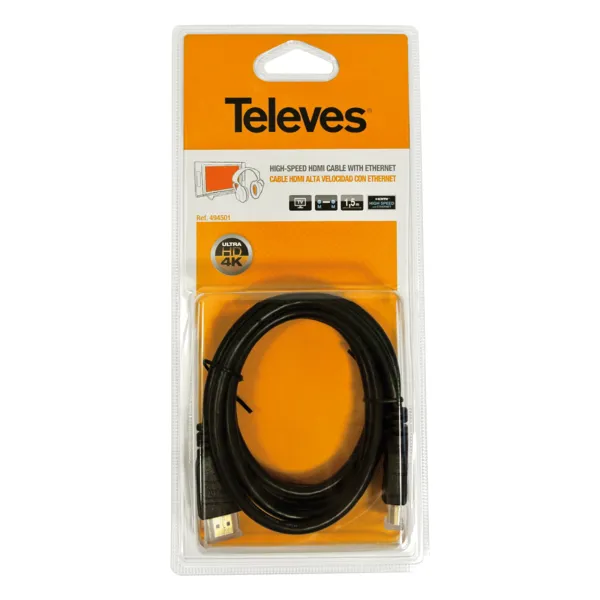
HDMI-to-HDMI cable, 1.5m, blister pack, Televes

Sign in to see user's data
zł40.29
0
Article number1041290
Payment methods
Please log in to see payment methods.
See


