Parameters
ConditionNew
Product description
No one can say for sure when exactly this historic moment occurred when the Panikorchester first played. Steffi Stephan, one of the co-founders, once said in an interview: "It all started on August 13th. Well, at least we agreed on that date retrospectively. It was definitely in the summer of 1973." August 13, 1973, was a Monday. James Bond's "Live and Let Die" was playing in cinemas, two months earlier Helmut Kohl had been elected chairman of the CDU, and the king in Afghanistan was overthrown. In Chile, a coup against Allende took place, and in Washington, Richard Nixon refused to resign after the Watergate scandal. In this supposedly good old time of the last millennium, a musical group was formed that would significantly influence the following years—at least as far as German rock was concerned: the Panikorchester. To pick up where Steffi Stephan left off with "Well," the answer to the question of why the Panikorchester was named exactly that has also been lost somewhere along the way. One story claims Udo Lindenberg coined the term "No Panic on the Titanic," while others believe the neon sign "Panic Exit" in the Kolpinghaus in Telgte, where the band was performing, sparked the idea. Whatever the truth, one person can shed light on the first historical mention of the term – the Panic Maestro himself: "The term 'Panic Orchestra' comes from the 1973 song 'Boogie Woogie Girl.' The lyrics include, 'The Panic Orchestra blew me away, and then you too, flipping around. Boogie Woogie Girl.'" The band's phenomenal success in the music industry over the past 50 years demonstrates once again what a fortunate coincidence accompanied the birth of the Panic Orchestra. The original lineup at Kanalstraße in Münster, where a barn had been converted into a rehearsal space, looked like this: Besides mastermind Udo Lindenberg, there was Steffi Stephan, Gottfried Böttger, Peter "Backi" Backhauen, Karl Allaut, and Judith Hodosi. Udo Lindenberg once succinctly summed it up: "1973 was the day the panic rocket blasted off towards Olympus. And even back then, people suspected its stellar flight would last a thousand years." Well, that much time isn't currently foreseeable, but the past 50 years have already accomplished a great deal. While the master himself contributed composition and/or lyrics to his works, creating the framework for the supporting dome of the artwork, and the producer provided the supporting pillars and delicate bay windows, it was always the Panikorchester that shaped the foundation, thus giving the songs on stage at shows and concerts in arenas and stadiums a virtuoso sound and stability. Udo Lindenberg: "The Panikorchester was the first German laid-back and easy-going show band with artists ranging from Rudi Ratlos to Ellie Pirelli to Öle Pinguin, my friend from Greenland/Dröhnland. And the band was consistently forbidden from any kind of stiff-animal behavior on stage." What's more, Udo Lindenberg himself administered the minimum blood alcohol test back then using original police breathalyzers – a minimum limit was prescribed, but the result could go any higher. "Always the slightly edgy party vibe and no more long-faced, uptight German rock." And: "We always knew we had the strongest lyrics and the sharpest compositions; everything else is performance. We're the new German rock 'n' roll rocket band anyway, haha (and if you don't believe it, have a drink? Yeah, that's how it was)." "Besides, we could always rely on good looks, which is very important in this industry (where they say: the eye hears too!)." As eventful as the history of the last 50 years has been, so diverse are the albums and musical pieces - from the 1973 hit "Alles klar auf der Andrea Doria," bi
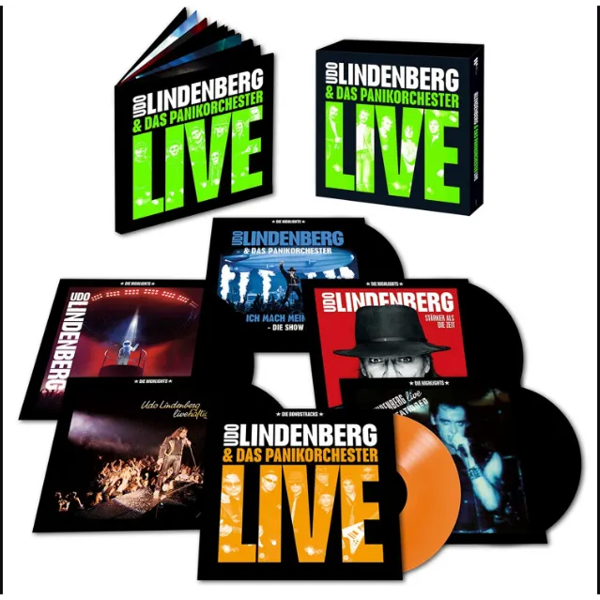
Udo Lindenberg Live (Limited Deluxe Box) 6 LPs Vinyl Box-Set Neu

Sign in to see user's data
€129.99
Article number1015473
Payment methods
Please log in to see payment methods.
Location
See
Category tags


